Models & Frameworks

Original thinking on neurodiversity, and belonging to create spaces where everyone feels valued.

EMBRACE DIFFERENCE. CREATE BELONGING.

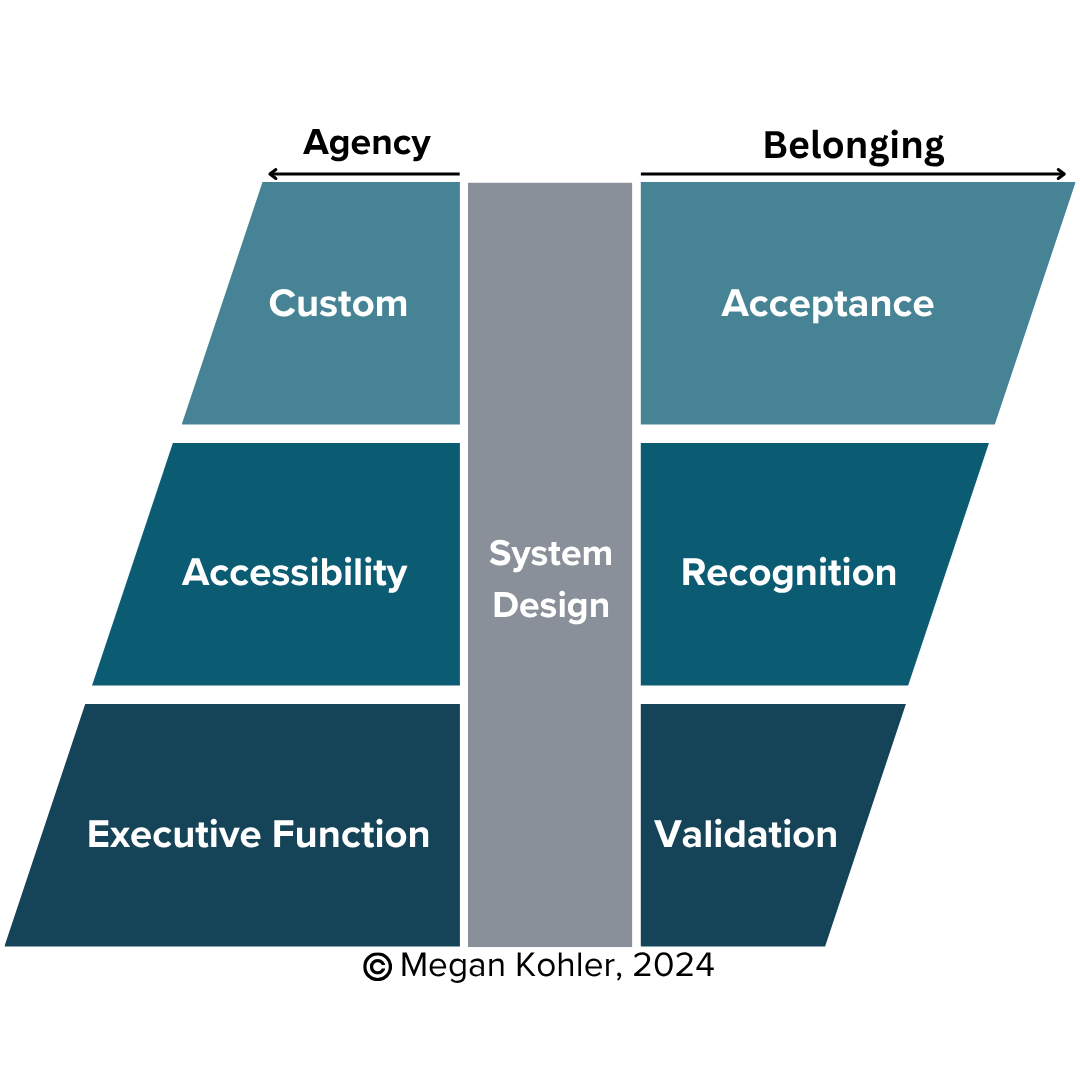
The Valued Minds Model

A three-principle model to redesign systems to ensure neurodiverse individuals thrive.

This model can be applied to:

  • Corporate

  • Education

  • Communities

The Valued Minds Model diagram displaying columns for Custom, Accessibility, and Executive Function under Agency, and Acceptance, Recognition, and Validation under Belonging, centered around System Design.

Want more information?

Additional Models and Approaches
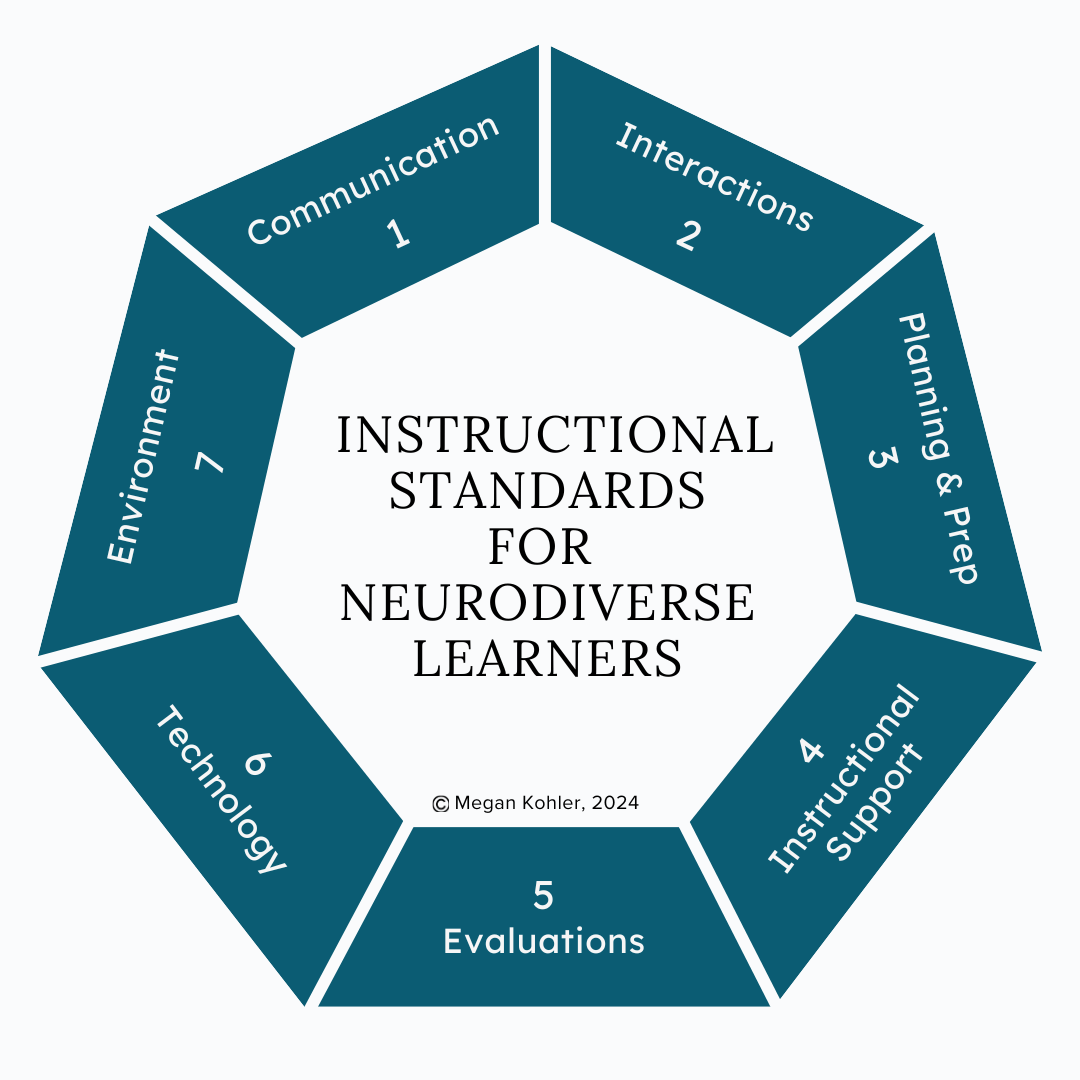
An octagonal diagram titled "Instructional Standards for Neurodiverse Learners." The perimeter features eight connected, numbered segments pointing inward: 1. Clarity, 2. Flexibility, 3. Visuals, 4. Scaffolding, 5. Reflection, 6. Engagement, 7. Collaboration, and 8. Assessment. The center circle reinforces the core objective: designing for inclusive academic environments.

Instructional Standards for Neurodiverse Learners

These standards provide an approach that instructional designers, faculty, and other educators can reference when engaging in neuroinclusive design initiatives.
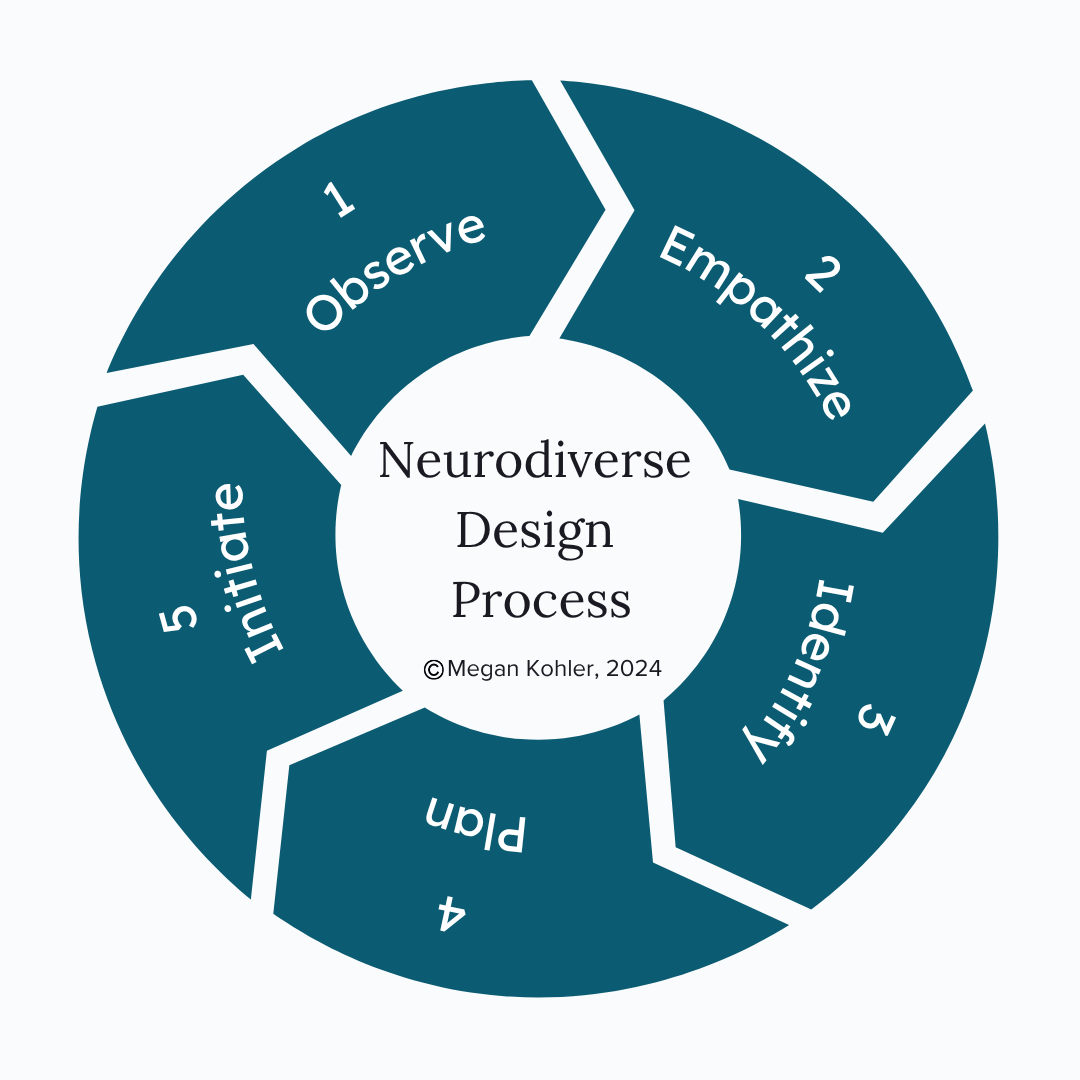
A cyclical, 4-step loop diagram showing a repeating workflow labeled "Neurodiverse Design Process, © Megan Kohler." The steps progress clockwise through distinct phases: 1. Observe, 2. Empathize, 3. Ideate, and 4. Pilot. Continuous directional arrows connect the phases to illustrate an iterative, ongoing improvement cycle.

Neurodiverse Design Process

This process offers a simple approach to understanding the unique qualities of neurodivergent individuals and enables you to help them reach their greatest potential.
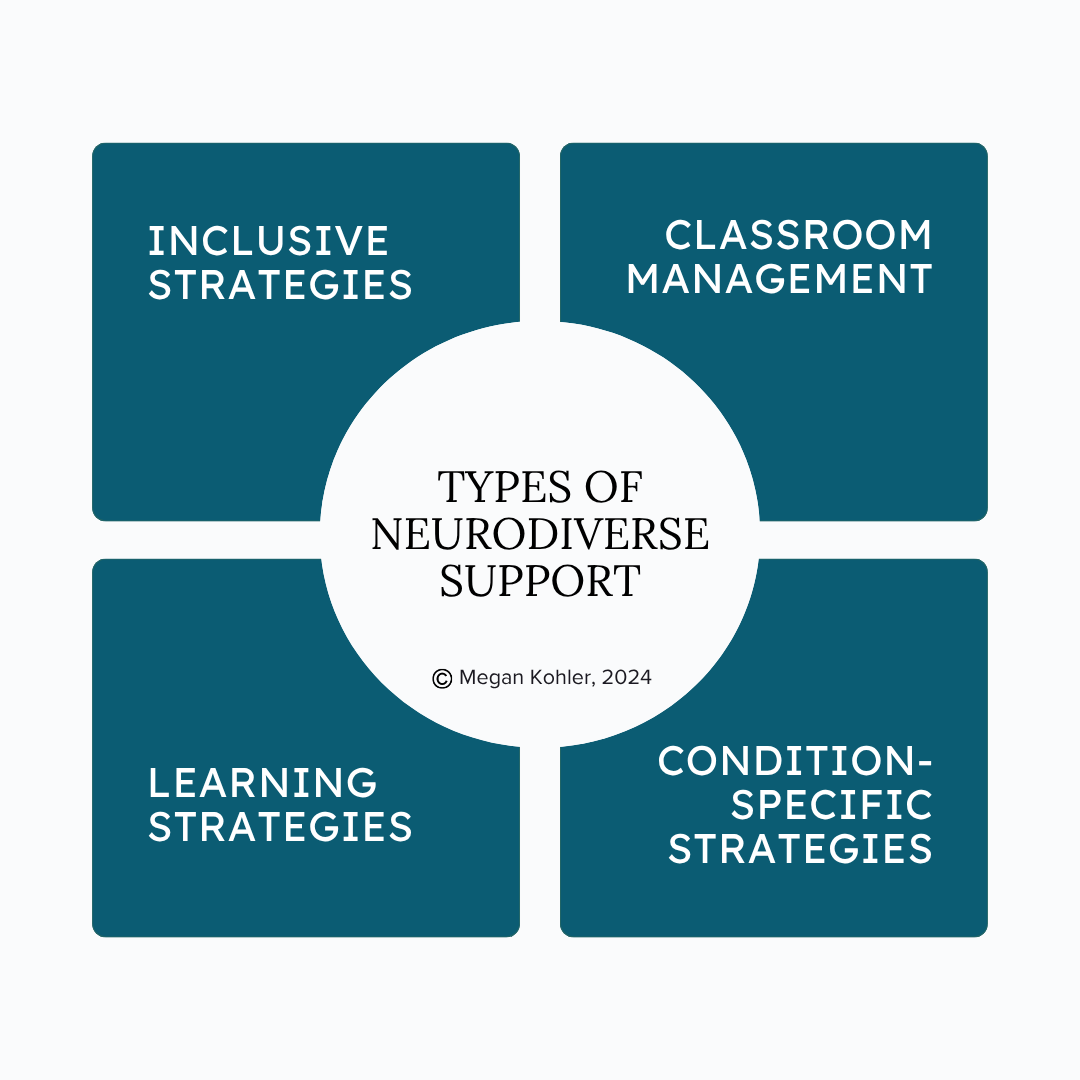
A clean, four-quadrant matrix layout titled "Types of Neurodiverse Support." The four corner boxes break down academic and professional support mechanisms into categorized quadrants: Top-left: Inclusive Strategies; Top-right: Classroom Management; Bottom-left: Learning Strategies; Bottom-right: Condition Specific Strategies.

Types of Neurodiverse Support

An approach designed to help establish a stronger understanding of the various types of support that can be offered to neurodiverse individuals and the benefits of each.